






STORY BY IRENE KABUKIE KWAO –
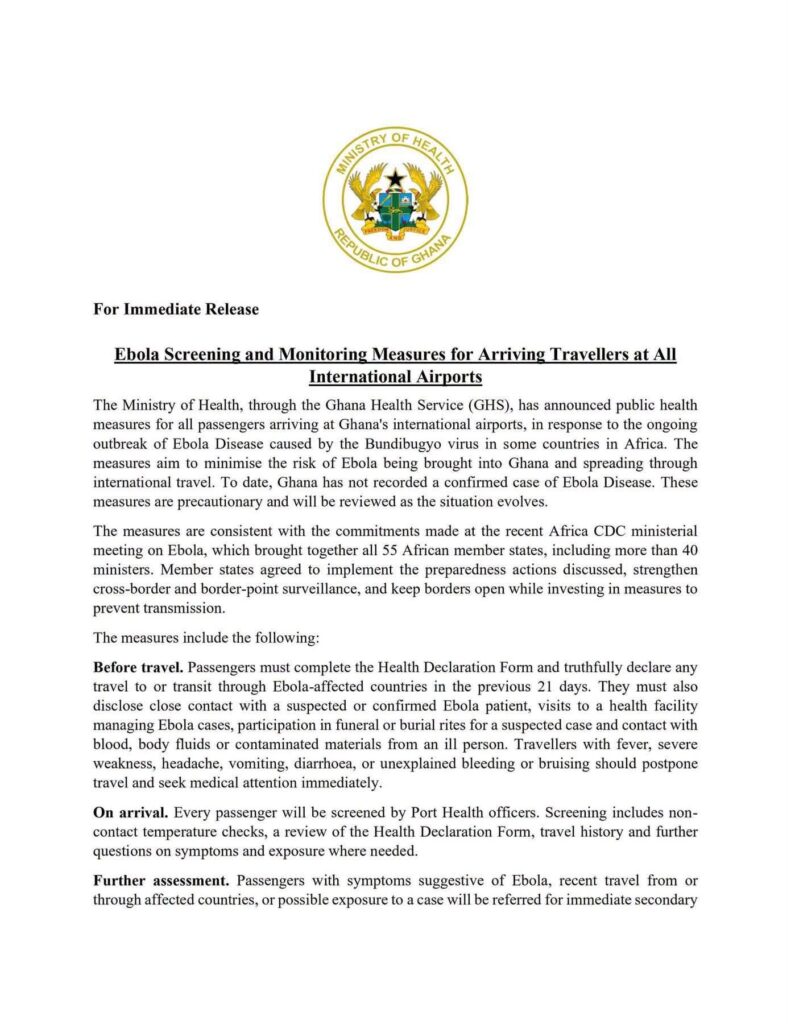
Ghana has introduced enhanced airport screening and a mandatory 21-day monitoring period for travellers arriving from countries experiencing ongoing transmission of the Bundibugyo strain of Ebola, as part of efforts to prevent the disease from entering the country.
The Ministry of Health announced the measures in a statement issued on Tuesday, November 3, explaining that the Ghana Health Service (GHS) would conduct follow-ups with affected travellers throughout the monitoring period.
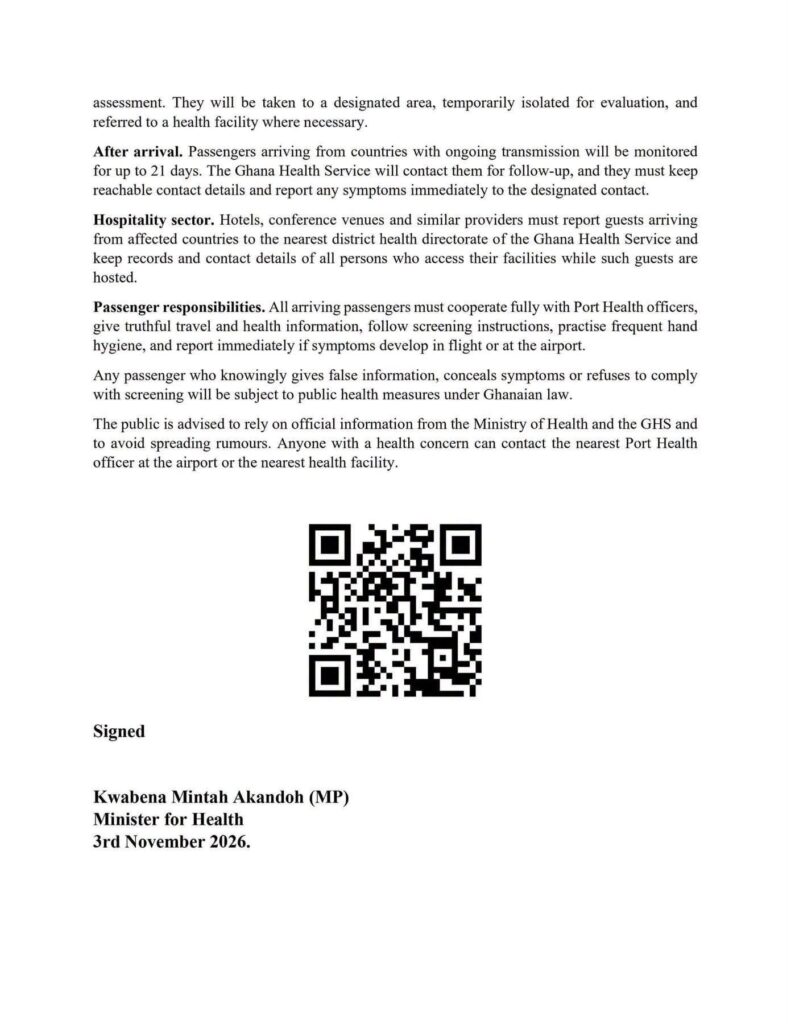
Under the arrangement, travellers will be required to provide accessible contact details and immediately report any symptoms that may develop within the 21 days.
All passengers arriving in Ghana will also undergo screening by Port Health officers, including temperature checks and assessments of their health declaration forms and travel histories.
Travellers must disclose any visits to or transit through Ebola-affected countries within the preceding 21 days, as well as any contact with suspected or confirmed Ebola cases.
Passengers exhibiting symptoms such as fever, vomiting, diarrhoea, severe weakness or unexplained bleeding will be referred for further medical assessment and, where necessary, temporary isolation and treatment.
The Ministry has warned that passengers who conceal symptoms, provide false information or refuse to cooperate with screening procedures could face public health measures under Ghanaian law.
Hotels, conference centres and similar establishments have also been directed to report guests arriving from affected countries to the nearest district health directorate and maintain their contact information.
Despite the heightened surveillance, the Ministry stressed that Ghana has not recorded any confirmed case of Ebola, describing the interventions as precautionary measures to safeguard public health.
The announcement comes amid concerns over the spread of the disease across parts of Africa. According to figures cited by the Africa Centres for Disease Control and Prevention (Africa CDC), the outbreak has reportedly recorded more than 10,400 confirmed cases and over 5,300 deaths, with the majority occurring in the Democratic Republic of Congo (DRC).
Uganda and Kenya have also reported confirmed infections, with Kenya recording its first-ever Ebola cases in October.
The Ministry has urged the public to remain calm, follow official health updates and avoid spreading unverified information about the outbreak.
It reaffirmed its commitment, alongside the Ghana Health Service, to strengthening disease surveillance and ensuring that appropriate measures are in place to protect the country from a possible Ebola outbreak.